
Week 1 Following Surgery – Splint to Cast
Week 2 Following Surgery – Atrophy and Exercise
Week 1
What does this surgery feel like, what can I expect with regards to recovery? Well… Other than the first few days of feeling underlying discomfort along the outside of my ankle and some irritation deep in the joint, most of the week has been relatively pain free. The posterior splint that ortho gave me immediately post-operatively became very loose and I was starting to get some pressure on the back part of my heel, which I brought up to the ortho team.
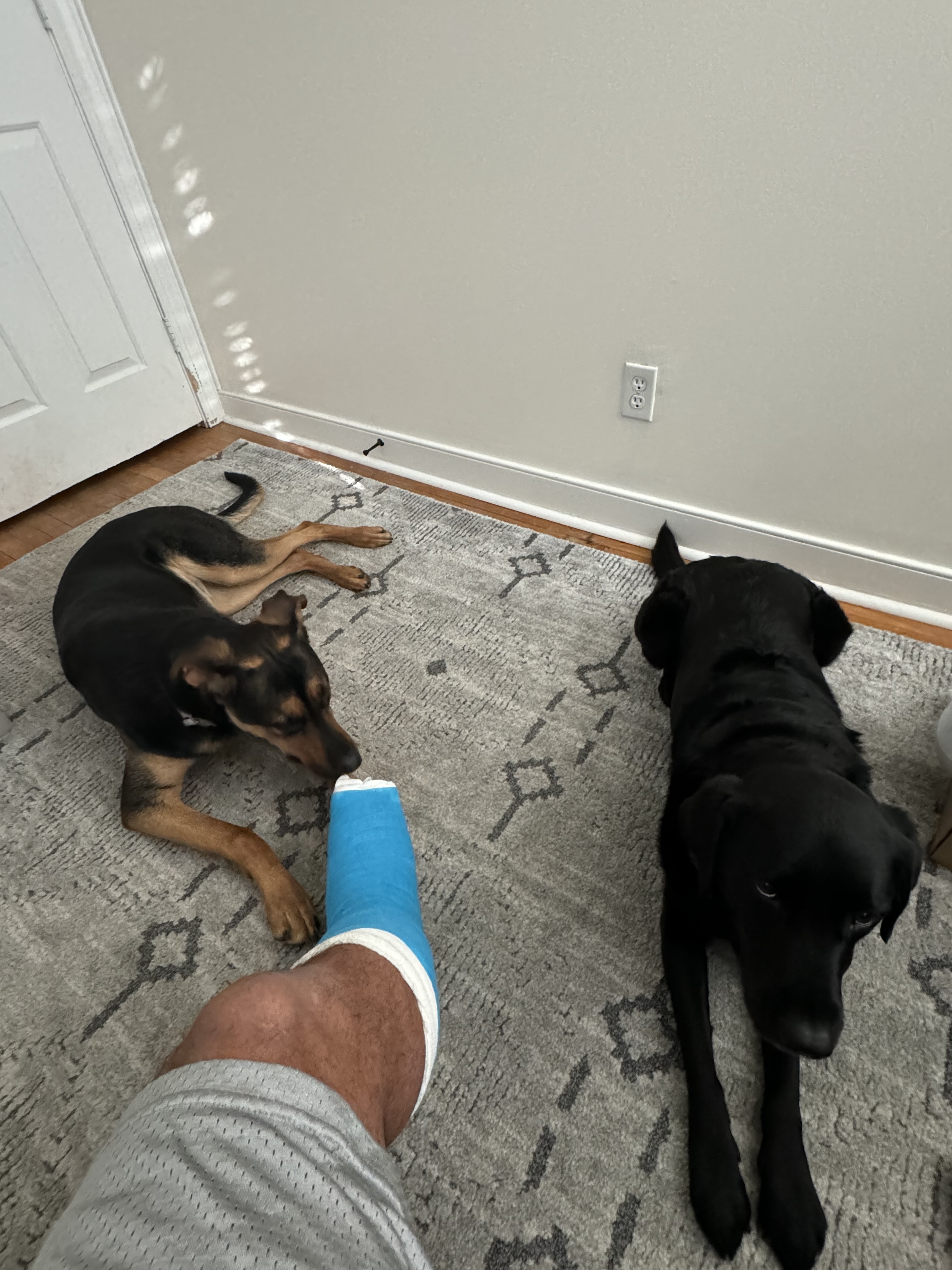
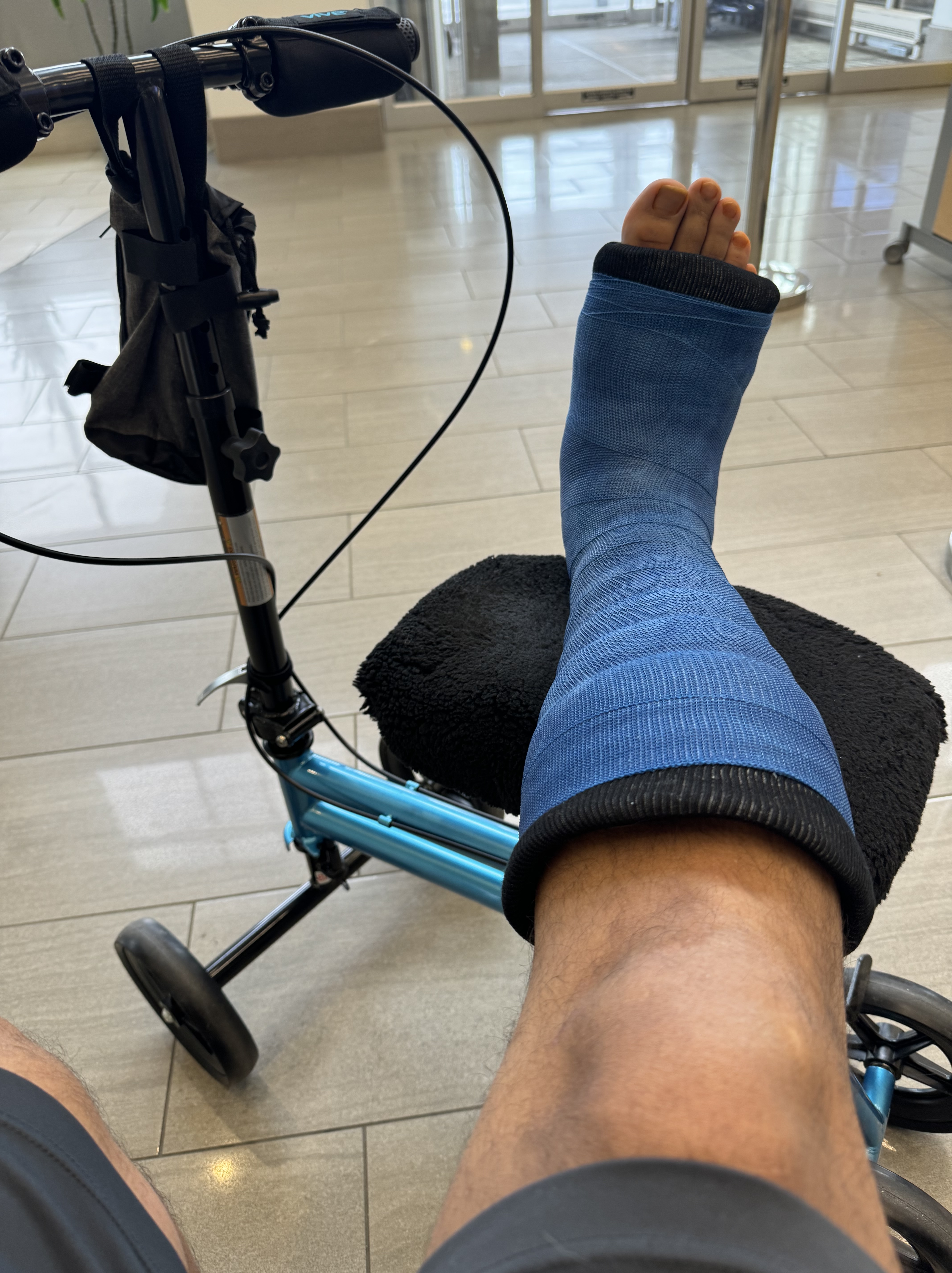
Though I was fine waiting until the end of week 2 to maybe try to convince them to place me in a CAM boot, they asked me to come in on a Saturday to check the splint. In the above image, I used a cohesive bandage to apply some light pressure to help with swelling and create a more snug fit after the swelling came down and it became loose. After consulting with the ortho team on Saturday Day 8 post-op, they removed the splint and placed me in a fiberglass cast, which is going to be there until my post-op visit on week 3.
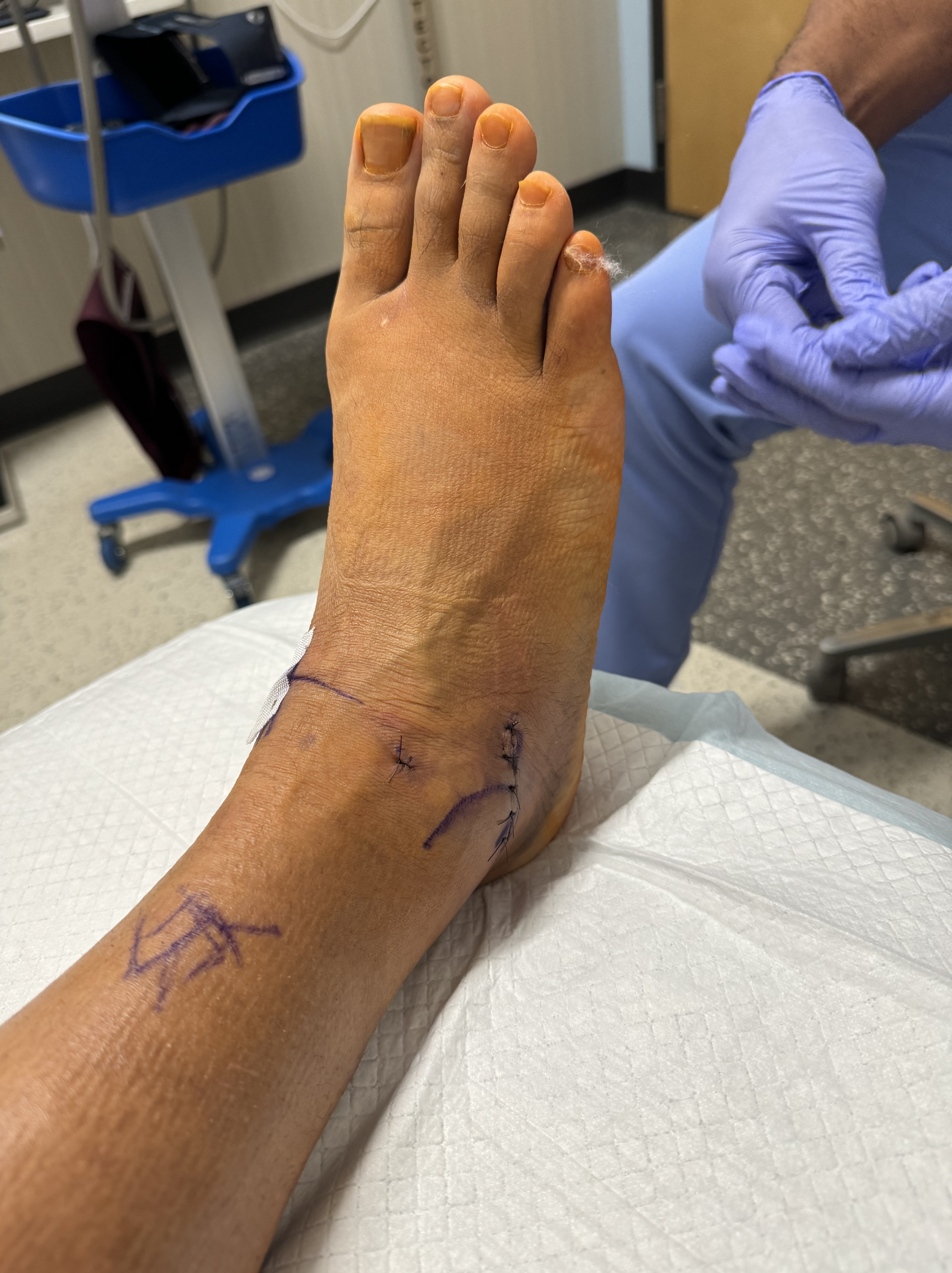
I did get a chance to see the lateral incision and the medial and lateral portals. To be honest, I didn’t realize how anxious I was. I had a nightmare the night before of my splint being removed and my entire foot was bloodied and flayed. Upon closer inspection, everything looked like it was healing very well.
Post-op protocol still dictates non-weightbearing until week 4. The cast actually provides a significant post-operative barrier and attenuates weightbearing forces going through the cast into the lower leg. In terms of it versus a posterior splint in offloading weightbearing forces and reducing foot joint mobility (protection), casting is superior in both conditions compared to a posterior splint. A properly fitted posterior splint will allow approx 3-4 degrees on initial weightbearing versus a fiberglass cast which allows only 2-3 degrees on initial weightbearing. In the foot and ankle, a difference of degrees can make huge difference. Overall, though I couldn’t get into a CAM boot, the cast was a better option for me in terms of protection and weightbearing security in the following weeks.
Week 2
Alright, in a cast for week 2 and so far everything has actually been feeling very good. I’m about 99% pain-free with only occasional twinges in the outside of my ankle when something hits the cast or if I leave my leg down in a dependent position for too long. Sensation is normal. I can feel everything in the cast from temperature, pressure, sensation of the stiches, all of which are great signs. One of the complications of this surgery is injury to the superficial peroneal nerve due to the location and process of the surgical procedure. Thankfully, I can tell that everything is working very well and that there is no superficial peroneal nerve complication.
In my mind, I need to work out and get back my prior activity level. I weighed myself on the scale and I lost about 10 pounds in one week, which I think is mostly due to atrophy of my R lower extremity musculature and healthier eating habits post-operatively being on leave from work. The lower leg atrophy is extremely noticeable. I always tell my patients that it only takes 1 week for deconditioning to set in and atrophy can occur rapidly when you significantly reduce use of a segment or a limb. With my R leg splinted and now casted, 11 days and I can squeeze my calf muscle on both sides and feel a significant difference in muscle mass and density. I need to hit the gym!
Since I still can’t weightbear, I’ve been going to the gym starting since day 10 and getting on the rowing machine for 30 minutes with my surgical leg off the edge of the foot pad so that most of my weight is on my left and only a very small bit is on my right heel and calf. After rowing cardio, I get on the floor and do some hip/leg stretches, core strengthening exercises and hip/knee strengthening exercises. After this I then go to lift machine weights. A knee scooter is immensely helpful here in that it has allowed me to transfer to and from the floor and support my leg when doing some exercises.
Below is my gym routine:
- Rowing Machine – 30 mins
- Supine Physioball under heels Double Knee to Chest
- Supine Physioball under heels SLR
- Supine Physioball under heels Long Axis Bridge
- Supine Physioball under heels Dynamic Hamstring Stretch
- Supine Physioball under knees Lower Trunk Rotations
- Supine Physioball under knees Short Axis Bridge
- Supine Modified Piriformis Crossover Lumbar Rotation Stretch
- Supine Dead Bugs at Alternating Leg touches starting from 90/90 Position
- Sidelying Hip Abd
- Seated Incline Chest Press
- Seated Row
- Seated Lat Pulldown
- Seated Bicep Curl
- Seated Overhead Tricep Ext
- Seated Long Arm Shoulder Ext
- Seated Scapular Stabilization – Letter “L”s w/ alternating head turns
- Seated Scapular Stabilization – Letter “W”s w/ alternating head turns
Previous: My experience with the Modified Brostrom with Internal Brace Surgery and Rehab
Next:
 Pure Journeys